
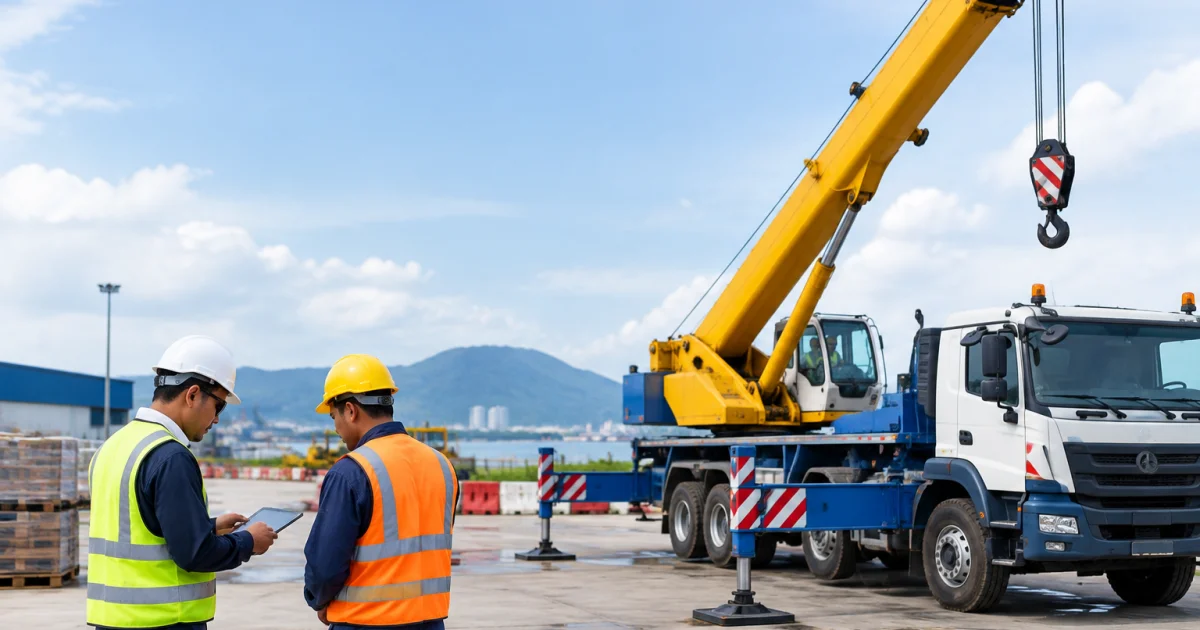
Booking a lorry crane can seem simple: confirm capacity, pick a date, and proceed. In reality, most risk sits around the lift—operator competency, correct configuration for your radius and ground conditions, and the provider’s ability to adapt when site plans change.
This guide helps buyers shortlisting a Lorry Crane Penang provider evaluate three areas before requesting quotes: safety credentials, fleet capacity and suitability, and on-site support. Use it as a practical checklist during calls, site visits, and method-statement reviews—especially for industrial plants, tight-access works, and time-critical shutdowns.
1) Start with safety credentials: what to ask and what to verify
Safety credentials aren’t just paperwork. They indicate trained people, controlled processes, and accountability. Your aim is to confirm the team is competent for your lift type, environment, and supervision needs.
Confirm operator and lifting team certifications (and match them to the scope)
Ask who will be assigned and what certifications/registrations apply to your site and equipment class. In Malaysia, buyers often check readiness for requirements such as CIDB, DOSH, and (where applicable) OGSP.
- Who is assigned (operator, rigger/slinger, signalman, supervisor)?
- Which certifications/registrations apply to this job and your site rules?
- Can they share copies for pre-qualification or induction?
If a provider can’t clearly define roles or responsibilities for slinging, signaling, and supervision, treat it as a warning sign. Safe lifting depends on a coordinated lifting team—not only the machine.
Look for lift planning discipline: method statement, risk assessment, and toolbox talks
A capable provider should be comfortable explaining how the lift will be planned and controlled. For many commercial and industrial lifts, expect:
- Pre-lift survey/site walk (especially for tight access or uncertain ground).
- Risk assessment reflecting real hazards (overhead lines, traffic, restricted swing, public interface, confined yards).
- Lift plan/method statement covering setup, outrigger spread, load path, exclusion zones, and communications.
- Toolbox talk on the day to align the crew on signals/radio and sequence.
Also ask what happens when conditions change (weather, blocked access, load differs). Strong safety culture includes clear escalation and stop-work authority.
Check equipment inspection and maintenance practices (without getting lost in technicalities)
You don’t need deep technical knowledge to assess readiness. Look for a consistent system:
- Scheduled maintenance and pre-use checks
- Inspection/maintenance history available on request
- Load charts accessible and understood by the operator
- Safety devices working (outriggers, indicators/alarms as applicable)
On your side, provide accurate load information (weight, dimensions, lifting points, and center of gravity if known). Even strong safety systems fail when load data is wrong.
2) Evaluate fleet capacity properly: tonnage is not the same as your usable lift
Common booking errors come from choosing by “tonnage” alone. Rated capacity varies with radius, boom length, and configuration. Your real requirement is weight + radius + height + site constraints.
Ask for the working range, not just the headline capacity
During quotation, ask the provider to confirm (plainly) the expected radius, boom length, and configuration. Share what you know:
- Pick and place points (crane position vs final placement point)
- Obstacles (roof edges, pipe racks, scaffolding, trees, setbacks)
- Required height and whether booming over obstacles is needed
- Load details (including rigging gear weight if relevant)
If the provider can’t explain why a specific unit works at your radius, they may be estimating. A good provider will ask clarifying questions and, if needed, propose an alternative setup or crane type to reduce risk.
Match the crane type to the site: lorry crane vs mobile crane vs rough terrain crane
Lorry cranes are efficient for combined transport + lift tasks and frequent repositioning. However, other equipment may be safer or more practical depending on conditions:
- Mobile crane: often better for heavier lifts, longer radii, or dedicated lifting configurations.
- Rough terrain crane: useful for uneven/soft ground or when off-road mobility is needed.
Don’t assume a recommendation to use a different crane is upselling. The better question is whether the proposed equipment achieves the lift with comfortable margin and a stable setup within your space constraints.
Confirm fleet availability and backup options (especially for time-critical shutdowns)
Fleet capacity also means operational resilience. Ask:
- Is a specific unit reserved, or is it “subject to availability”?
- What is the breakdown/late-arrival contingency?
- How quickly can a replacement or additional support be mobilized in Penang?
If your work involves maintenance windows, night shifts, or tight sequences, confirm staffing and support won’t be stretched across overlapping jobs.
3) Assess on-site support: the difference between a lift that happens and a lift that finishes
Two providers may quote similar equipment, but stronger coordination and supervision often determine whether the job finishes safely and on time.
Clarify who is responsible for key on-site decisions
Before booking, align responsibilities for:
- Traffic control and barricading
- Signaling and communications (hand signals, radios, designated signalman)
- Ground bearing checks and safe outrigger placement (including mats/plates if needed)
- Lifting gear selection (slings, shackles, spreader beams if required)
- Stop-work authority and escalation route
Even for small lifts, unclear ownership creates unsafe pressure. A reliable provider will define roles and integrate with your permit-to-work and site safety requirements.
Look for site readiness habits: arrival checks, setup time, and exclusion zones
Ask what they need from you to set up efficiently. Practical expectations include:
- A clear, level setup area and defined access route
- Time allowance for outrigger deployment and levelling
- Exclusion zone boundaries and control of pedestrians/vehicles
- Coordination with other trades (MEP, scaffolding, deliveries)
In busy Penang industrial parks, these basics prevent last-minute relocation, reduced capacity from increased radius, and avoidable delays. For tight sites, confirm whether a site visit and positioning plan can be done before the lift day.
Integrate lifting with your broader logistics (transport, offloading, placement)
Many scopes aren’t lift-only. You may need coordinated Transportation Penang support: collection from a vendor, delivery to site, offloading, and final placement.
If transport is included, confirm route planning, timing windows, and safe unloading. For long, wide, or unusual loads, ask whether specialized trailers (such as low loaders or other heavy transport configurations) are required. One provider managing both transport and lifting typically reduces handover risk and scheduling friction.
4) Questions to compare quotes fairly (and avoid hidden risk)
To compare providers accurately, ensure each quote is based on the same assumptions. Low prices can reflect exclusions like rigging gear, supervision, or extra mobilizations caused by weak planning.
Use a “same-scope” quote checklist
Ask every provider to confirm in writing:
- Equipment details: model/class, capacity range, and configuration assumptions (radius/height).
- Crew: operator only, or operator + rigger/slinger + signalman + supervisor?
- Duration: minimum hours, standby charges, mobilization/demobilization.
- Rigging gear: included/excluded; who supplies slings/shackles/spreader (if needed)?
- Site constraints: access limitations, permits/inductions, work interface requirements.
- Safety deliverables: lift plan/method statement, risk assessment, toolbox talk.
If the lift requires access equipment for guiding installation or alignment at height, consider whether one provider can coordinate both lifting and access equipment such as skylifts. If relevant, review Skylifts Boomlifts And Scissorlifts.
Watch for common mismatch points that cause delays
- Radius underestimated: the crane must stand farther away due to obstacles, reducing usable capacity.
- Ground not assessed: soft ground/underground services prevent safe outrigger loading.
- Load information incomplete: actual weight or lifting points differ from what was provided.
- Insufficient crew: missing rigger/slinger or signalman shifts burden to your team.
- Access not secured: other trades, vehicles, or materials block the setup area.
Use these points in pre-job coordination and as a final readiness check the day before the lift.
5) A simple pre-booking scorecard you can use today
To rank providers quickly, score each item 0–2 (0 = unclear, 1 = partial, 2 = clear/confirmed). The total highlights where risk sits and what must be clarified before approval.
| Category | What “good” looks like | Your notes |
|---|---|---|
| Credentials | Relevant CIDB/DOSH/OGSP readiness (as applicable), named roles, documents available | |
| Lift planning | Site survey offered, risk assessment + method statement, clear communications plan | |
| Equipment fit | Capacity explained at your radius/height; correct configuration assumptions stated | |
| Fleet availability | Specific unit reserved; backup plan explained; realistic schedule commitment | |
| On-site support | Supervisor/rigging support available; barricading and coordination approach stated | |
| Logistics integration | Can handle lorry transport, delivery timing, offloading, and placement under one plan |
Low scores don’t automatically disqualify a provider—they show what to verify before signing off. For broader context, see Top 5 Benefits Of Hiring A Crane In Penang For Your Construction Project.
Conclusion: book with confidence by validating people, machine, and site support
Choosing a lorry crane provider isn’t only about availability. It’s about confirming they can run a controlled operation on your site: certified personnel, disciplined lift planning, suitable equipment and configuration, and practical on-site support.
By checking credentials, validating radius and configuration assumptions, and clarifying responsibilities on the day, you’ll reduce delays, improve safety, and compare quotations fairly—leading to a smoother lift and a schedule that holds.
Frequently Asked Questions
What documents should I request from a lorry crane provider before work starts?
Request the lift plan or method statement (when required for the job), a risk assessment, operator/crew certification details (as applicable to your site), and basic equipment inspection/maintenance records relevant to the lift. Also confirm who will act as rigger/slinger, signalman, and on-site supervisor.
Is the crane’s rated tonnage enough information to choose the right lorry crane?
No. Usable lifting capacity depends on working radius, boom length, lift height, and configuration (including outrigger setup). Share your pick-and-place points and obstacles so the provider can confirm the correct crane configuration and safe margin for your specific lift.
When should I consider a mobile crane or rough terrain crane instead of a lorry crane?
Consider a mobile crane for heavier lifts, larger radii, or jobs needing a more dedicated lifting setup. Consider a rough terrain crane when the site has uneven or soft ground, or when off-road mobility is needed. A good provider should explain equipment selection based on your site constraints, not just availability.
Can one provider handle both transport and lifting for industrial equipment moves in Penang?
Yes, some providers coordinate transportation, delivery timing, offloading, and final placement under one plan. This can reduce handover risk and scheduling delays—especially for machinery relocation, plant maintenance shutdowns, and tight-access sites.
Do I need a multi-axle low loader for heavy or oversized cargo in Penang?
It depends on the load’s weight, length, and axle loading requirements, as well as route constraints and site access. If the cargo is unusually heavy or long, ask the provider to assess whether a low loader (including multi-axle configurations) is required and to plan the safest transport-and-offload method.
Need a safer, smoother lorry crane booking in Penang?
Poh Seng Transport Sdn Bhd supports lift planning, crane rental, heavy lifting, and coordinated transport so your team can execute with clearer roles, safer setup, and fewer on-site surprises. Share your load details, site constraints, and timeline—our team can help you shortlist the right equipment and support level for your job.
Disclaimer:
We hope you found this article informative. The content is provided for general informational purposes only and does not constitute professional advice or fully represent the services offered by Poh Seng Transport Sdn. Bhd.
Readers are encouraged to consult a qualified industry professional or contact our team for solutions tailored to their specific project needs. While we strive for accuracy and completeness, we cannot guarantee that the information is entirely error-free. Poh Seng Transport Sdn. Bhd. assumes no responsibility for any errors or omissions.