
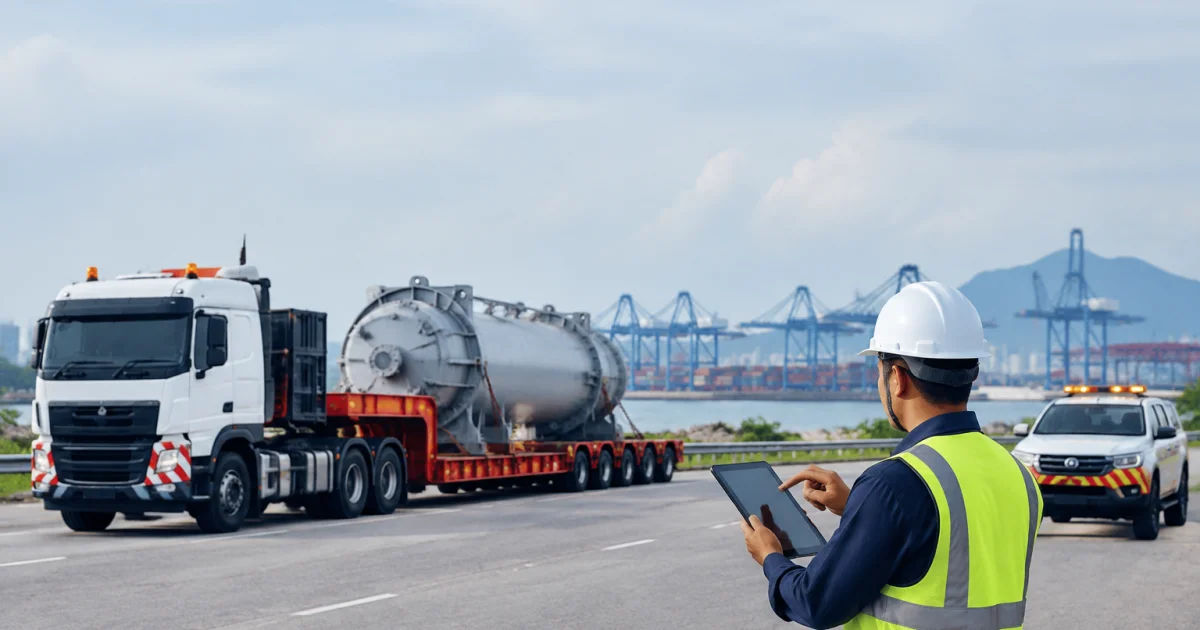
In Penang’s industrial corridors, transport and heavy lifting decisions are increasingly shaped by the same pressures: tighter schedules, higher safety expectations, and more stakeholders who want visibility throughout a move. For procurement teams and project managers, the question has shifted from “Can you move it?” to “Can you move it safely, compliantly, and with trackable control?”
This is where Transportation Penang becomes more than a location-based search. It often reflects the need for a partner that can handle abnormal loads, coordinate lifting and transport under one plan, and produce documentation that stands up to audits and client HSSE requirements—without slowing execution.
Below is a buyer-focused view of what the market expects from transporters and heavy lift providers in Penang today: what “compliance” typically looks like in practice, why GPS tracking now matters operationally, and how to qualify service scope (cranes, lorry cranes, low loaders, forklifts, and access equipment) to avoid gaps during mobilisation.
1) Compliance expectations: what buyers want to see before work starts
In industrial transport and heavy lift work, compliance is rarely one document. Buyers usually want evidence that people, equipment, and methods can be controlled end-to-end: competence, correct equipment for the working configuration, and planning proportional to risk.
Across manufacturing expansions, machinery installation, shutdowns, port-side handling, and infrastructure works in Penang, buyers commonly validate:
- Competent personnel and safety credentials: operators/supervisors with certifications and registrations aligned to site rules (for example, CIDB, DOSH, or OGSP where required).
- Equipment fitness and capacity match: cranes, lowbed trailers, lorry cranes, forklifts, and access equipment sized for actual radius, reach, ground conditions, and configuration—not just rated capacity.
- Documented planning: method statements, risk assessments, and lift/transport plans covering ground bearing, exclusion zones, rigging, and sequencing.
- Clear interfaces: defined responsibilities between transporter, riggers, site management, and any escort/traffic support.
A practical sign of a mature provider is how early they ask for the right information. Beyond a single weight figure, they typically request drawings, dimensions, centre of gravity (if known), pick-and-carry constraints, loading bay limits, and permit-to-work requirements. Early detail reduces late changes that cause rework, delays, or compromised controls.
Practical buyer checklist: compliance items that reduce surprises
- Who owns the lift plan? Confirm whether the provider supplies lift planning and on-site supervision or whether your team must provide these.
- What is the mobilisation package? Ask what is standard (equipment particulars, operator competency evidence, RA/MS, and pre-start briefing format).
- What is the escalation path? If conditions change (soft ground, blocked access, reduced outrigger area), who can approve changes and how quickly?
2) GPS tracking and visibility: from “nice to have” to operational control
GPS-equipped fleets reduce coordination friction when multiple resources must align. In industrial logistics, small delays compound: a late low loader can affect a crane booking; a delayed crane can compress a shutdown window; a late escort can force rescheduling.
For buyers, GPS tracking is less about a map pin and more about predictability. Reliable status updates help coordinate:
- Gate and security access timing at industrial parks and port-adjacent facilities.
- Crane and rigging readiness so site teams are not waiting idle.
- Delivery sequencing for multi-drop moves (for example, relocating multiple machines or skids).
- Exception management when route constraints or traffic require rerouting or re-timing.
Best results come when tracking is paired with an agreed communication rhythm: who updates whom, how often, and what triggers escalation. During heavy haulage moves—where timing and route constraints matter—buyers increasingly expect consistent, repeatable reporting.
Poh Seng Transport Sdn Bhd highlights GPS-equipped trucks as part of its coordination approach, which can reduce blind spots between dispatch, arrival, and unloading—especially when transport is paired with lifting services under a tight schedule.
3) What service scope buyers expect: transport + lifting + access under one plan
In Penang, industrial moves rarely end at “deliver to site.” Many buyers prefer one accountable partner for transport, lifting, positioning, and handover support rather than stitching together multiple vendors with unclear boundaries.
In evaluations, buyers often compare providers across these capability areas:
- Transport service breadth: low loaders/lowbed trailers for heavy machinery, cargo trailers for general moves, pole trailers for long loads where needed, and suitable prime movers.
- Mobile crane availability: the ability to supply a suitable mobile or rough terrain crane for offloading, installation support, and heavy lifting sequences.
- Lorry crane options: practical for smaller lifts, multi-point deliveries, or sites where a larger crane setup is inefficient.
- Forklift and mover services: internal movement, final positioning, and controlled relocation inside warehouses or factory floors.
- Skylift and access equipment: support for elevated installation, M&E works, and maintenance tied to the same mobilisation window.
Buyers also increasingly value project management and consultancy support such as route planning, feasibility checks, and translating site constraints into an executable move plan. Even with internal engineering, a logistics partner that can turn constraints into a workable sequence reduces back-and-forth.
Where “one-stop” matters most
Bundling is not automatically better, but it can reduce risk when your move involves multiple handoffs. One-stop coverage often helps for:
- Industrial relocation where loading, transport, offloading, and positioning must be sequenced to restart production.
- Shutdown windows where cranes, forklifts, and transport must meet tight timings.
- Restricted sites where access equipment is needed immediately after delivery for installation work.
If skylift work is in scope, align procurement evaluation with safety planning requirements. See: How to safely lift heavy equipment using a skylift in Penang.
4) How buyers evaluate safety process maturity (beyond a generic “safety first”)
Many providers can supply a crane and a trailer. The differentiator is often process maturity: consistent execution under pressure while keeping risk controlled. Buyers tend to look for evidence in workflow, not just statements.
Common evaluation angles include:
- Pre-job planning discipline: site visit practices, measurement verification, lift-point identification, and ground bearing review for crane setup.
- Toolbox brief quality: briefings tailored to the specific hazards, with clear role assignments.
- Equipment selection logic: how choices are made between mobile crane, lorry crane, and forklift handling, accounting for radius, headroom, reach, and load control.
- Incident prevention culture: willingness to stop and re-plan if conditions change instead of pushing through to meet time.
A practical buyer approach is to request a walk-through of the provider’s sequence for a similar job (without confidential details). Look for operational controls such as exclusion zones, tag lines, outrigger mats, traffic control, and permit coordination.
When heavy lifting is central to your scope, align evaluation with the provider’s capability and planning depth. Overview: Heavy Lifting.
5) Commercial questions buyers are asking: timelines, route planning, and accountability
In commercial investigation, buyers want a provider who can respond quickly with a clear, credible plan—without overpromising. In Penang, planning often must account for traffic peaks, access restrictions, and site readiness that may not align perfectly with transport arrival.
Questions increasingly raised in procurement calls and clarifications include:
“Can you coordinate route planning and site access?”
Expectations now include routing feasibility for oversized cargo, turning radii, and arrival sequencing. Even if permits or escorts are handled elsewhere, buyers value early constraint flagging to avoid last-minute replans.
“What is included in the quote—and what is not?”
Scope clarity is a major concern. Confirm whether pricing includes rigging gear, spreader beams, packing, loading bay support, or only point-to-point transport. Strong quotations state inclusions and assumptions (crane setup area, floor loading limits, and whether night work is required).
“How do you prevent delays when multiple equipment types are needed?”
Fleet depth and scheduling capability reduce dependency risk, especially when a standby plan exists. Poh Seng Transport Sdn Bhd operates a fleet of more than 70 cranes, trucks, machinery, and equipment, supporting different project sizes and timelines across Malaysia.
“Who is accountable on-site?”
Buyers increasingly prefer a single on-site lead who can coordinate transporter crew, crane operator, riggers, and the site representative. Clear accountability helps resolve access or sequencing changes quickly without unsafe improvisation.
“Do you provide crane rental service options that match our constraints?”
Crane selection is constrained by more than capacity: setup area, headroom, reach, and ground conditions matter. When comparing crane rental, assess planning support and equipment range—not only daily rates. Reference: Crane Rental.
Conclusion: what “good” looks like when choosing a transport and heavy lift partner in Penang
Penang’s industrial transport and heavy lift market is rewarding providers who can demonstrate control: competent people, fit-for-task equipment, clear planning documents, and reliable coordination supported by tracking and disciplined communication. The strongest outcomes typically come from matching the partner’s scope and process maturity to the project’s real complexity—especially when transport, lifting, positioning, and access work must be sequenced in a narrow window.
When evaluating providers, focus on practical indicators: how they gather information, state assumptions, manage change, and provide on-site accountability. These factors reduce schedule risk, avoid scope gaps, and support safer execution from mobilisation to handover.
Frequently Asked Questions
What compliance documents should I request from a transporter or heavy lift provider in Penang?
Request a method statement and risk assessment for the move/lift, evidence of competent operators and supervisors (as required by the site), and equipment details that show suitability for the working configuration (not just rated capacity). Also confirm roles and responsibilities for supervision, rigging, and site interfaces.
How does GPS tracking help industrial transport projects beyond knowing the truck location?
GPS tracking improves coordination: it supports more accurate arrival updates, helps align cranes and rigging teams with delivery timing, and reduces idle time during loading/unloading windows. It is most effective when paired with an agreed communication process for delays, rerouting, and on-site access changes.
When should I use a lorry crane instead of a mobile crane in Penang projects?
A lorry crane is often practical for lighter to mid-range lifts, multi-point deliveries, or sites where a full mobile crane setup is inefficient. A mobile or rough terrain crane is generally preferred for heavier lifts, longer radii, complex rigging, or where tighter control and planning are required.
Do industrial moves typically include positioning and installation, or only transport?
Many industrial moves require more than point-to-point transport. Buyers often need offloading, final positioning, internal relocation support, and sometimes packing or installation assistance. Clarify in writing what is included (transport, lifting, rigging, forklift handling, access equipment) to avoid scope gaps after award.
Can I hire a multi-axle low loader in Penang for oversized machinery?
Yes, multi-axle low loader configurations are commonly used for heavy or oversized cargo where load distribution and stability are important. The right configuration depends on cargo dimensions, weight, centre-of-gravity considerations, route constraints, and loading/unloading conditions, so a provider should confirm these details during planning.
Plan a compliant, trackable heavy move with Poh Seng Transport Sdn Bhd
If your project needs industrial transport plus lifting, positioning, or access equipment in Penang, Poh Seng Transport Sdn Bhd can support end-to-end planning and execution—from route and mobilisation coordination to crane, lorry crane, low loader, forklift, and skylift requirements.
Share your cargo details (dimensions, weight, site constraints, timing window), and our team will help you align compliance documents, equipment selection, and on-site coordination for a smoother delivery and lift sequence.
Disclaimer:
We hope you found this article informative. The content is provided for general informational purposes only and does not constitute professional advice or fully represent the services offered by Poh Seng Transport Sdn. Bhd.
Readers are encouraged to consult a qualified industry professional or contact our team for solutions tailored to their specific project needs. While we strive for accuracy and completeness, we cannot guarantee that the information is entirely error-free. Poh Seng Transport Sdn. Bhd. assumes no responsibility for any errors or omissions.